Developing an entirely new mobility system requires more than a convincing digital model. Engineers need physical parts that allow them to assess fit, refine tolerances, validate mechanical interfaces and understand how a design will perform under real-world conditions.
For Cyclopic Ltd, functional 3D printing prototypes produced through the StrongParts bureau provided a fast and flexible route from an innovative concept to a fully testable assembly.
Why Cyclopic Needed Functional 3D Printing Prototypes
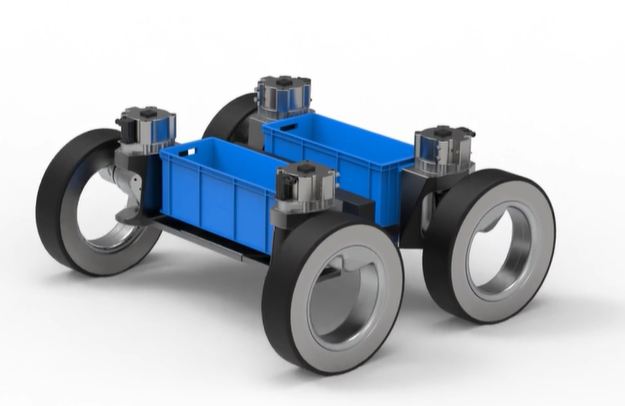
Cyclopic is developing an innovative centreless wheel and modular electric vehicle platform. Its design integrates drive, steering, suspension and braking into a unified, all-electric unit with potential applications across the rapidly evolving micro-mobility market.
During the early stages of development, Cyclopic needed strong, accurate prototypes of the centreless wheel and its associated drive components. These parts had to provide more than a visual representation of the concept. They needed sufficient accuracy and mechanical performance to support functional validation, ergonomics assessment and real-world testing.
Producing the components through conventional manufacturing methods would have been expensive and time-consuming, particularly while the designs were still evolving. Cyclopic needed a more agile approach that would allow its engineers to test, learn and refine the system without committing to production tooling.
Accessing Industrial 3D Printing Through StrongParts
Following an initial meeting at the iAero Centre, the StrongParts team proposed a bureau-based additive manufacturing workflow using Markforged industrial 3D printers.
Using a bureau service allowed Cyclopic to access the required printing technology, materials and engineering expertise without investing in its own equipment. It also meant that production could begin quickly, helping the development team maintain momentum.
The project involved a range of components with different sizes, geometries and performance requirements. StrongParts distributed these parts across multiple printers, selecting the most appropriate system for each component. By printing concurrently rather than waiting for each part to be completed sequentially, the team reduced the overall production lead time.
Reducing Cost Without Compromising Functionality
StrongParts worked closely with Cyclopic to establish clear and accurate pricing for the project. Through a series of online discussions, the two teams reviewed the models and identified opportunities to reduce production costs while preserving the functionality required for testing.
This collaborative review reduced the initial projected printing cost by 20%.
Cost reduction was not achieved simply by selecting a cheaper material or lowering the quality of the finished parts. Instead, the teams considered how each component would be used, the loads it would experience and the level of performance it genuinely required.
This ensured that material and production decisions were based on the needs of the application.
Optimising the Designs for Composite 3D Printing
Successful bureau production often involves more than receiving a file and placing it on a printer. The way a component is designed and prepared can have a significant effect on its strength, accuracy, print time and cost.
StrongParts engineers worked with Cyclopic’s design team to review and adapt the digital CAD models in line with composite additive manufacturing design principles. This helped ensure that the components could be produced efficiently while retaining the features and mechanical performance needed for testing.
The collaboration also gave Cyclopic access to practical Markforged application knowledge throughout the project. Design decisions could be discussed before printing, reducing the likelihood of unnecessary iterations and helping the team get more value from each build.
Selecting Materials for Real-World Testing
Different parts of the Cyclopic platform had very different functional requirements, so a single material would not have been suitable for every component.
The tyres were produced using TPU, a flexible material that allowed Cyclopic to simulate real-world contact and movement. Structural components were printed in Onyx, Markforged’s carbon-fibre-filled nylon, providing a combination of strength, toughness and dimensional stability.
Where components were expected to experience particularly high loads, continuous carbon-fibre reinforcement was added to provide greater strength and stiffness.
This application-led material selection allowed the prototype to reproduce more of the mechanical behaviour required for meaningful evaluation. Cyclopic could therefore move beyond checking appearance and basic assembly and begin conducting genuine functional testing.
From Digital Models to a Functional Unit in Weeks
Within a matter of weeks, Cyclopic had its first functional unit under test.
These functional 3D printing prototypes allowed Cyclopic’s engineers to refine geometries, adjust tolerances and evaluate mechanical interfaces before progressing to more expensive manufacturing stages.
The prototypes also provided something that digital models alone could not: a tangible, working representation of the concept. This helped strengthen stakeholder understanding and confidence, supporting continued investment in research and development.
Most importantly, the printed components were strong enough to support real-world testing. Cyclopic could use the prototype to learn how the system behaved in practice and feed those findings directly back into the design process.
More Than a 3D Printing Service
The Cyclopic project demonstrates how an industrial 3D printing bureau can support innovation without requiring a business to develop every capability internally.
Through StrongParts, Cyclopic gained access to:
- Multiple industrial 3D printers for parallel production
- Composite and flexible engineering materials
- Continuous-fibre reinforcement for highly loaded components
- Design guidance for composite additive manufacturing
- Application-led material selection
- Clear pricing and practical cost optimisation
- Fast production of functional, testable parts
This combination of equipment, materials and engineering support enabled Cyclopic to progress from digital concept to physical validation faster and with less risk than a conventional development route.
For businesses with occasional requirements, evolving designs or projects requiring specialist materials, bureau production provides a practical way to access industrial additive manufacturing when it is needed. It can also support existing printer users when a project requires additional capacity, larger build volumes or capabilities beyond their in-house equipment.
Turn Your Design into a Functional Part
Whether you are developing an early-stage concept, producing specialist tooling or need additional capacity for an established application, StrongParts can help you select the right production approach.