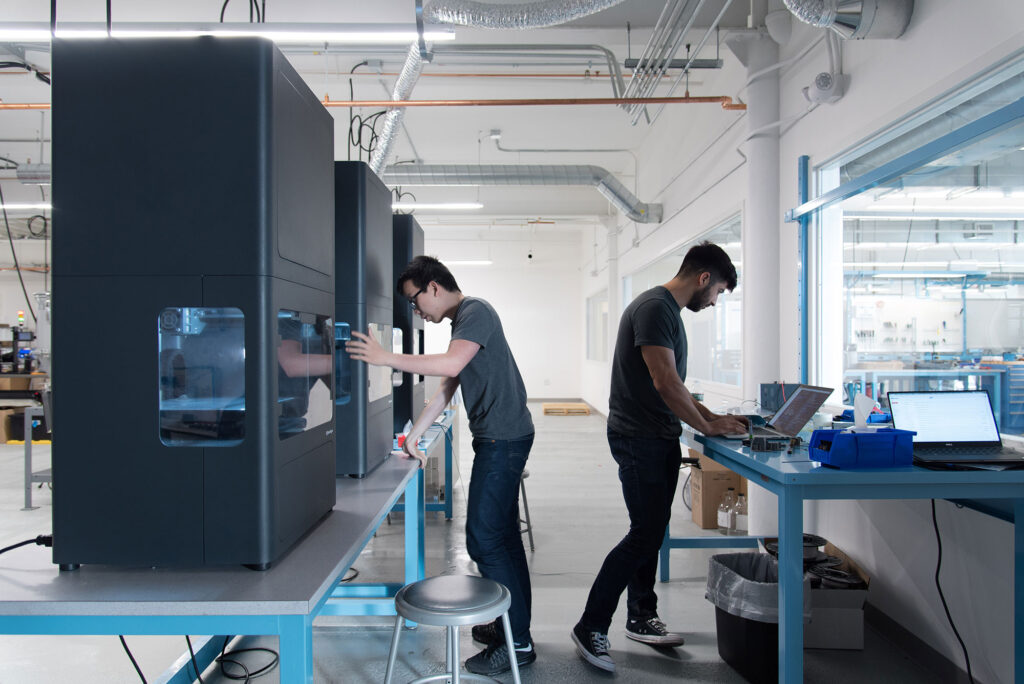
The decision around in-house vs outsourced 3D printing is not always straightforward. Both approaches can give manufacturers a faster and more flexible way to produce prototypes, tooling, fixtures, replacement parts and low-volume components.
For some manufacturers, investing in an in-house system provides the greatest value. For others, accessing industrial 3D printing through a bureau is more practical. Increasingly, businesses are combining the two through a hybrid production model.
The right approach depends on the frequency of demand, the urgency of the application, the equipment and materials required, and the resources available within the business.
So, which approach is right for you?
When Does In-House 3D Printing Make Sense?
Bringing industrial 3D printing in-house can transform the way engineering and production teams respond to everyday requirements.
Designs can move directly from CAD to production without waiting for an external supplier. Engineers can make changes, produce another version and test the revised part within a much shorter development cycle.
In-house printing is particularly valuable when:
- Parts are required frequently
- Designs change or evolve regularly
- Fast response is operationally important
- Engineers need direct control over production
- The printer can support several teams or departments
- There is a consistent pipeline of suitable applications
- Sensitive designs need to remain within the business
Applications such as manufacturing jigs, assembly fixtures, inspection gauges, robot grippers and replacement components can provide regular demand. In these situations, the printer becomes a practical production resource rather than equipment reserved for occasional prototyping.
Ownership also allows a business to build internal additive manufacturing knowledge. Engineers become more familiar with designing for the process, selecting materials and identifying further applications where 3D printing can reduce cost or lead time.
However, equipment ownership also brings fixed costs and operational responsibilities. The business must consider printer utilisation, materials, maintenance, staff training and the internal time required to manage production.
The strongest case for bringing 3D printing in-house is therefore not simply that a part can be printed. It is that the organisation has sufficient recurring demand to make regular access strategically and financially valuable.
When Is Outsourcing the Better Option?
Not every manufacturer will produce enough parts to justify owning an industrial system. A business may have a genuine requirement for strong, accurate 3D printed components but only need them occasionally.
Using an industrial 3D printing bureau provides access to the technology when it is required, without committing capital to equipment that may be underused.
Outsourcing can be the better choice when:
- Requirements are occasional or difficult to predict
- Only a small number of parts are required
- The business is testing whether an application is suitable
- A project requires specialist materials or equipment
- Internal staff do not have the time to manage production
- The cost of equipment cannot yet be justified
- Expert advice is needed on design or material selection
This approach converts equipment ownership and operating costs into a variable production cost. The business pays for the parts and support it needs without taking on the wider responsibility of running the equipment.
Bureau production can be particularly valuable during product development. Early designs often change, and the final production requirement may still be uncertain. Outsourcing allows engineers to produce functional prototypes, validate an application and establish likely demand before deciding whether further investment is appropriate.
A capable bureau should also provide more than machine time. Practical guidance on part orientation, composite design, reinforcement, material selection and production strategy can improve the outcome and reduce unnecessary iterations.
What Is a Hybrid 3D Printing Model?
The choice between in-house and outsourced production does not have to be permanent or absolute.
Many manufacturers benefit from a hybrid model in which everyday requirements are produced internally, while an external bureau provides additional capacity or capabilities when needed.
For example, a business might use its own printer for urgent tooling, fixtures and maintenance parts. StrongParts could then support larger production runs, unusually large components or applications requiring materials and equipment not available internally.
A hybrid model is particularly useful when:
- Internal printers are operating near capacity
- A large order would disrupt routine production
- Demand fluctuates throughout the year
- A deadline requires several printers to operate concurrently
- A part exceeds the available build volume
- A project requires composite, high-temperature or metal capability not held in-house
- The business wants to trial a new application before purchasing additional equipment
This provides the responsiveness of internal production while giving the organisation access to a wider manufacturing resource when requirements change.
It can also prevent internal equipment from becoming a bottleneck. Instead of delaying an urgent maintenance part because the printer is occupied with a large batch, the batch – or the urgent part – can be transferred to a trusted production partner.
Three Common Reasons for Using a 3D Printing Bureau
Although every application is different, most bureau requirements fall into three broad categories.
1. Access Without Equipment Ownership
Some businesses will never have enough recurring demand to justify purchasing their own industrial 3D printer. They may only require a prototype, replacement component or small batch of production parts a few times each year.
For these companies, bureau production provides access to the benefits of additive manufacturing while keeping costs directly connected to demand.
2. Additional Capacity for Existing Users
Printer owners may experience periods when demand exceeds their internal capacity. A new order, urgent project or larger production run can quickly fill the available print schedule.
Using a bureau for overspill production allows the business to meet deadlines without disrupting its everyday applications or making a capital investment based on a temporary peak.
Where compatible equipment and materials are used, production can be distributed between the customer and the bureau as part of the same project.
3. Access to Additional Capabilities
A business may already own a 3D printer but encounter an application that exceeds its build volume or material capability.
Rather than purchasing another system for a single project, it can use a bureau to access larger-format composite printing, specialist engineering materials or metal additive manufacturing.
This allows existing users to extend what they can produce without being limited by the equipment currently installed.
In-House vs Outsourced 3D Printing: How Should You Decide?
When comparing in-house vs outsourced 3D printing, consider how each model fits your demand, internal resources and application requirements.
How Frequently Will You Need Parts?
Regular, repeatable demand strengthens the case for ownership. Occasional or uncertain requirements generally suit outsourcing.
It is useful to review demand across the entire organisation rather than within one department. Engineering, production, maintenance, quality and research teams may all have potential applications.
How Quickly Are Parts Needed?
If engineers regularly need parts within hours or days, immediate access to an in-house printer can be extremely valuable. Where deadlines are less frequent or can be planned, a bureau may provide sufficient flexibility.
Are Volumes Consistent?
Predictable workloads are easier to support internally. Large peaks and irregular batches may favour outsourcing or a hybrid approach.
What Equipment and Materials Are Required?
Build volume, part strength, temperature resistance, chemical exposure, flexibility and other application requirements will influence the production technology and material needed.
A printer may support most everyday requirements while a bureau provides access to specialist capabilities for exceptions.
What Is the True Cost?
The comparison should not be limited to the purchase price of a printer or the quoted price of a part.
For in-house production, consider utilisation, materials, maintenance, training and staff time. For outsourced production, consider part cost, delivery time, engineering support and the value of accessing equipment only when required.
Is Demand Likely to Grow?
Bureau production can help a business validate applications and build a clearer picture of demand. If outsourced requirements become regular and predictable, purchasing equipment may eventually become the more economical option.
Equally, existing printer owners can use overspill production to assess whether a rise in demand is sustained before adding further internal capacity.
Choosing a Model That Can Evolve
The most appropriate production model today may not be the right one in two years – or even six months.
A manufacturer may begin by outsourcing occasional parts, move to in-house production as demand grows, and continue using a bureau for additional capacity and specialist applications. Another business may own a printer but choose to outsource a large batch rather than disrupt critical internal work.
When considering in-house vs outsourced 3D printing, the important question is not which model is universally better. It is how each approach can support the requirements, resources and priorities of your business.
By treating industrial 3D printing as a flexible manufacturing capability rather than simply a piece of equipment, manufacturers can select the right production route for every application.
Need Help Assessing Your Requirements?
StrongParts provides industrial composite and metal 3D printing for businesses that need occasional access, additional production capacity or capabilities beyond their existing equipment.
Share your part file, quantity, application requirements and required delivery date with our team, and we can help you identify an appropriate production approach.